
Offertech 2025 Report: Digital Fraud, Fake Websites and Brand Protection
Digital fraud no longer operates on the margins of the internet.
It is in the feed, in sponsored ads, on marketplaces, in domains that look almost official, in profiles that simulate customer support, in fake websites that copy legitimate stores and in shopping experiences that feel real until the consumer loses money, data and trust.
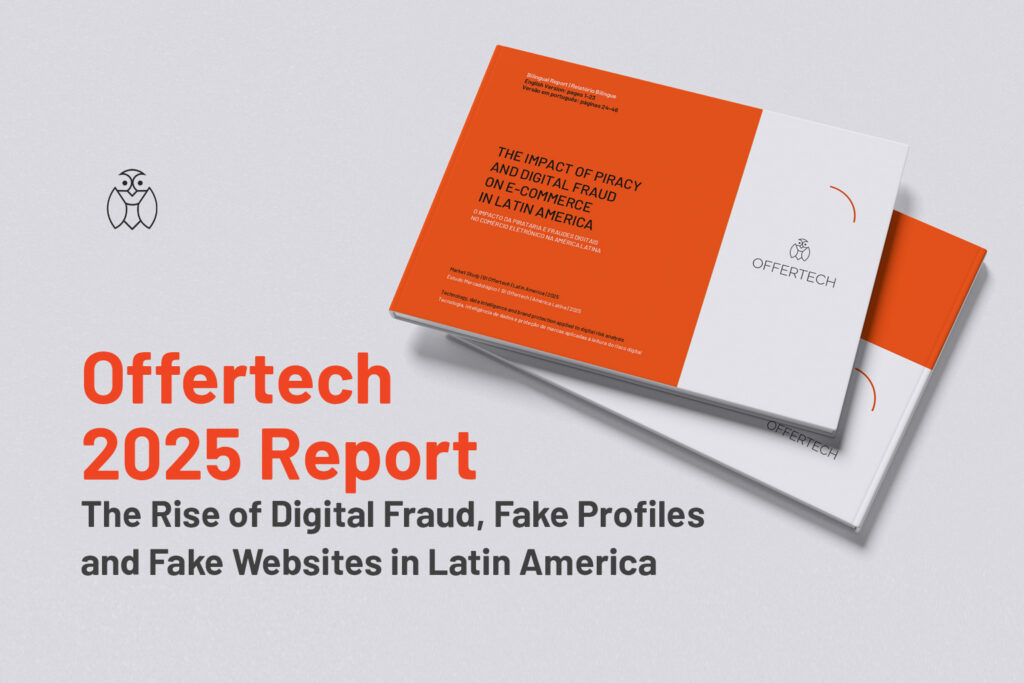
The Offertech 2025 Annual Report — The Impact of Piracy and Digital Fraud on E-Commerce in Latin America shows that online illegal activity has evolved into an organized, fast-moving system that increasingly resembles legitimate commerce.
Offertech analyzed 5.3 million ads and pieces of content published on e-commerce platforms and social media operating in Latin America, covering 19 countries and 12 market segments.
The report reveals a central finding: 31.2% of the online sales analyzed in Latin America involved illegal or counterfeit products.
In other words, roughly 3 out of every 10 ads analyzed were associated with illegal activity.
This number is not only about piracy.
It points to a new reality for brands: in the digital environment, a company’s reputation can be used by third parties to sell illegal products, run scams, capture data, divert consumers and compromise trust built over years.
That is why brand protection is no longer a reactive action.
Today, online brand protection is a strategic business function.
What Did the Offertech 2025 Report Analyze?
The study was built from Offertech’s operational database throughout 2025, consolidating monitoring data related to digital piracy, counterfeiting, unauthorized brand use and digital fraud in Latin American e-commerce.
The analyzed base includes:
- 5.3 million ads and pieces of content analyzed;
- 19 countries monitored across Latin America;
- 12 market segments tracked;
- marketplaces, social media and private e-commerce websites;
- ads, profiles, domains, sellers, products and suspicious content.
The monitored segments include fashion and accessories, footwear, electronics and mobile devices, hygiene, health and beauty, sporting goods, football clubs, home and decoration, perfumery, auto parts, food and beverages, toys and utilities.
The analysis considered objective indicators of illegality, such as unauthorized use of registered trademarks, lack of regulatory registration, prohibited products, illegally imported goods, incompatible pricing and visual patterns associated with counterfeiting.
This approach allows digital fraud to be understood not as an isolated event, but as a parallel commercial structure.
Online Illegal Activity Follows the Growth of E-Commerce
Latin America experienced one of its strongest e-commerce growth cycles in 2025.
According to the report, online retail sales of physical products in the region reached USD 191.25 billion, with 12.2% growth compared to the previous year.
E-commerce growth expands legitimate sales opportunities.
But it also expands the risk surface.
The more consumers buy online, the more channels fraudsters can use to capture attention, trust and payment.
The report indicates that approximately 1 in every 3 dollars moved through Latin American e-commerce is exposed to the illegal economy.
This is a decisive insight for companies.
Digital illegal activity is not only stealing occasional sales.
It is competing for traffic, trust, attention and conversion.
31.2% of Online Sales Analyzed Involve Illegal Products
One of the strongest findings in the Offertech 2025 Report is the illegality rate identified through monitoring.
In 2025, 31.2% of the online sales analyzed in Latin America involved illegal or counterfeit products.
In the previous study, conducted in 2024, this rate was 29.5%.
The increase of 1.7 percentage points shows a structural upward trend.
This matters because it shows that digital piracy is not decreasing as e-commerce matures.
On the contrary.
It is adapting.
Fraudsters are using more sophisticated channels, paid ads, social media, fake profiles, similar domains and professional-looking pages to appear trustworthy.
The consequence is clear: brands that sell online, advertise online or have a relevant digital presence need to treat brand protection as operational infrastructure.
Social Media Concentrates 78% of Detected Illegal Ads
The report shows that 78% of ads classified as illegal were identified on social media platforms.
Marketplaces represented 19% of detections, while private e-commerce websites accounted for 3%.
This data changes how companies should think about brand protection.
For a long time, digital piracy was mainly associated with marketplaces.
But today, social media has become an environment of discovery, influence and conversion.
Consumers see products, click on ads, start conversations, receive offers and are redirected to external pages.
It is also where many risks emerge:
- fake profiles;
- informal stores;
- illegal ads;
- cloned pages;
- fake promotions;
- unauthorized sellers;
- scams using well-known brands.
The combination of reach, speed and low friction makes social media one of the main risk surfaces for brands.
252 Million Followers Impacted by Illegal Ads
The reach of illegal activity on social media goes beyond the number of ads.
According to the Offertech 2025 Report, profiles identified as distribution channels for illegal products collectively had more than 252 million followers.
This number shows that piracy and digital fraud do not operate in invisible spaces.
They appear in the daily consumption journey of millions of people.
For brands, the impact is significant.
A fake or irregular profile is not only publishing an ad.
It is using audience.
It is using commercial language.
It is using social proof.
It is using influence mechanisms.
And, in many cases, it is using the identity of legitimate brands to reduce consumer distrust.
This is one of the reasons why fake profiles have become one of the most critical risks for companies with a digital presence.
Fake Websites Have Become One of the Main Forms of Digital Fraud
The report dedicates an important section to fake websites, identifying this format as one of the most widespread forms of fraud in Latin American e-commerce in 2025.
Fake websites are pages created to precisely imitate legitimate brands and stores.
They may reproduce:
- logos;
- color palettes;
- product descriptions;
- customer reviews;
- exchange policies;
- payment pages;
- commercial offers;
- the appearance of a legitimate e-commerce store.
The fraud cycle is direct.
The operator registers a domain with a small variation of the official name, builds a fake page, invests in paid traffic and directs consumers to an apparently legitimate shopping experience.
After payment, the product is not delivered, contact is blocked and the domain may be abandoned or recreated under another identity.
This type of fraud does not affect only the consumer.
It compromises the credibility of brands without consistent digital protection.
The Problem Is Not Only the Fake Product. It Is the Fake Shopping Experience.
One of the most important insights from the Offertech 2025 Report is that digital fraud has evolved.
The problem is no longer limited to counterfeit products.
It involves appropriation of visual identity, exploitation of brand trust and the creation of fake shopping experiences.
This summarizes the new risk scenario.
The fraudster does not need to build trust from zero.
They use the trust the brand has already built.
They copy visual signals.
They simulate customer service.
They buy traffic.
They create urgency.
They offer a simple payment method.
And they turn reputation into a fraud mechanism.
That is why online brand protection needs to go beyond the removal of pirated products.
It needs to monitor the full digital risk journey.
Fake Domains: The Technical Detail That Becomes a Commercial Scam
The Offertech 2025 Report also analyzed domain extensions used by fraudsters in fake websites.
The .com extension led with 24.2% of occurrences, mainly because it immediately conveys credibility to consumers.
Extensions associated with digital retail, such as .site, .shop, .online and .store, accounted for 41.5% of cases.
The presence of .br in 3.6% of fake websites also deserves attention, because this extension requires a valid company registration in Brazil. This suggests the use of false business documentation or third-party company registrations, raising the level of fraud organization.
This reinforces an important thesis: fake websites are not always improvised.
In many cases, they are structured operations.
And structured operations require continuous protection, not occasional searches.
Payment Methods Reveal the Logic of Fraud
The report also identified patterns in the payment methods used by fake websites.
In 35.3% of cases, the only option offered was instant payment.
According to Offertech’s analysis, this format is used by fraudsters because it is difficult to reverse and reduces the consumer’s ability to recover losses.
Another 20.7% of fake websites offered multiple payment methods, simulating the appearance of a legitimate e-commerce store.
In addition, 17.8% of websites had the payment page disabled at the time of detection, suggesting operations in preparation or dormancy to make removal more difficult.
The data shows that digital fraud operates in cycles.
It appears, pauses, changes, returns and adapts.
That is why monitoring must be permanent.
The Potential Impact of Digital Piracy Reaches USD 61.2 Billion per Year
Based on the illegality rate identified by Offertech and applied to the total e-commerce market in Latin America, the potential impact of digital piracy in the region was estimated at up to USD 61.2 billion per year.
This number positions online illegal activity as an economic issue, not only a legal one.
Combating piracy and digital fraud should be understood as an agenda for:
- revenue preservation;
- consumer protection;
- competitive integrity;
- trust in e-commerce;
- sustainability of the digital ecosystem;
- brand value protection.
Companies that do not monitor their online exposure may be losing more than sales.
They may be losing control over how their brand appears, circulates and is perceived.
Brand Protection: Why the Report Changes Brand Priorities
The Offertech 2025 Report shows that digital illegal activity directly affects audience, trust, conversion and reputation.
This changes how companies should understand brand protection.
Online brand protection is not just taking down a fake profile.
It is not just removing a cloned website.
And it is not just reporting pirated products.
Brand protection is a continuous operation designed to protect the brand in environments where third parties can exploit its reputation.
This operation involves:
- social media monitoring;
- marketplace monitoring;
- search engine monitoring;
- protection against fake websites;
- identification of fraudulent domains;
- fake profile removal;
- illegal ad monitoring;
- digital piracy combat;
- seller analysis;
- risk classification;
- evidence collection;
- recurrence monitoring;
- dashboards and data intelligence.
In the digital environment, a brand is not present only where it publishes.
It is also present wherever third parties use its name without authorization.
Fake Profiles: The Risk Born Inside Trust
Fake profiles are dangerous because they approach consumers in relationship environments.
They do not need to wait for someone to visit a website.
They approach.
They comment.
They respond to direct messages.
They simulate customer service.
They create promotions.
They redirect links.
They use the brand’s images and language.
When a consumer is deceived by a fake profile, the negative experience can be transferred to the real company.
Even if the brand is also a victim, it still suffers the impact.
The consumer’s perception may be simple:
“I don’t know which channel I can trust anymore.”
That doubt is enough to reduce conversion and weaken the relationship.
Fake Websites: When the Brand Becomes the Scene of the Scam
Fake websites are even more dangerous because they recreate an entire shopping experience.
Fraud stops being only a suspicious message.
It becomes a store.
With layout.
Product.
Price.
Checkout.
Reviews.
Policies.
Domain.
Ad.
Everything is designed to reduce distrust.
This is the critical point: the consumer does not only fall for a scam. They enter an experience that looks official.
For brands, this means that protecting domains, visual identity, ads and digital channels is an essential part of reputation protection.
What Should Companies Do After Reading the Offertech 2025 Report?
The first step is to understand that digital exposure needs to be measured.
It is not enough to assume the brand is protected because it has an official website, verified social media accounts or an active marketing team.
The company needs to answer objective questions:
- Are there fake profiles using our brand?
- Are there domains similar to our official website?
- Are paid ads using our name improperly?
- Are our products appearing irregularly on marketplaces?
- Are fake websites copying our visual identity?
- Are consumers being redirected to unofficial channels?
- Are unauthorized sellers using our images?
- Is our brand associated with phishing or scams?
- Can we quickly remove a critical occurrence?
- Do we have data on recurrence?
Without these answers, the brand operates in the dark.
With data, it begins to protect value.
How Offertech Turns Data Into Online Brand Protection
The Offertech 2025 Report shows the scale of the risk, but it also points to the response path.
Brand protection needs to combine technology, regulatory understanding, specialized human analysis and removal capacity across multiple environments.
Offertech operates at this intersection.
The platform detects, classifies, prioritizes and removes illegal content that exploits brands, products, commercial channels and consumer trust.
Beyond removal, Offertech turns operational data into market intelligence to protect brand value.
The operation includes:
- artificial intelligence;
- 24/7 monitoring;
- specialized analysis;
- large-scale removal;
- recurrence tracking;
- dashboards;
- online brand diagnosis;
- action across social media, marketplaces, search engines, websites and domains.
More than fighting illegal activity, Offertech helps brands preserve trust, protect revenue and strengthen their digital presence.
Conclusion: Digital Fraud Now Looks Like Legitimate Commerce
This is the central point of the Offertech 2025 Report.
Digital fraud no longer necessarily looks amateur.
It uses legitimate channels.
It uses paid media.
It uses design.
It uses commercial language.
It uses profiles.
It uses domains.
It uses payment methods.
It uses trust.
And, in many cases, it uses well-known brands to appear real.
That is why companies that still treat fake profiles, fake websites and digital piracy as isolated problems may be underestimating the risk.
In the digital environment, there is no middle ground.
Either the brand is protected.
Or it is exposed.
Request an Online Brand Diagnosis with Offertech
Your brand may be used in fake profiles, fake websites, illegal ads, fraudulent domains, marketplaces and digital scams without your company knowing.
Request an online diagnosis with Offertech.
Discover where, how and by whom your brand is being exploited in the digital environment.
FAQ About the Offertech 2025 Report, Fake Profiles and Fake Websites
What Does the Offertech 2025 Report Show?
The report shows the impact of piracy and digital fraud on e-commerce in Latin America, with data on illegal ads, social media, marketplaces, fake websites, fraudulent domains, payment methods and brand protection.
How Many Ads and Pieces of Content Were Analyzed?
Offertech analyzed 5.3 million ads and pieces of content published on e-commerce platforms and social media in Latin America.
What Was the Main Finding of the Report?
One of the main findings is that 31.2% of the online sales analyzed in Latin America involved illegal or counterfeit products.
Where Are Illegal Ads Concentrated?
According to the report, 78% of detected illegal ads were found on social media, 19% on marketplaces and 3% on private e-commerce websites.
Why Are Social Media Platforms Relevant to Digital Fraud?
Because social media combines discovery, influence, relationship and conversion. It allows fake profiles, illegal ads and fraudulent pages to circulate quickly.
What Are Fake Websites?
Fake websites are pages created to imitate legitimate brands or stores, copying visual identity, products, descriptions, reviews and commercial policies to deceive consumers.
How Do Fake Websites Harm Brands?
They compromise trust, divert consumers, capture payments and may cause the real brand to be associated with the negative experience of fraud.
What Is Brand Protection?
Brand protection is online brand protection against unauthorized use across digital channels, including fake profiles, fake websites, illegal ads, piracy, phishing, marketplaces and fraudulent domains.
Why Do Companies Need Online Brand Protection?
Because the brand can be used illegally outside official channels, in environments that affect revenue, reputation, traffic, conversion and consumer trust.
How Can a Company Start Protecting Its Brand?
The first step is to perform an online diagnosis to identify where the brand is exposed, which risks are active and which occurrences should be prioritized.