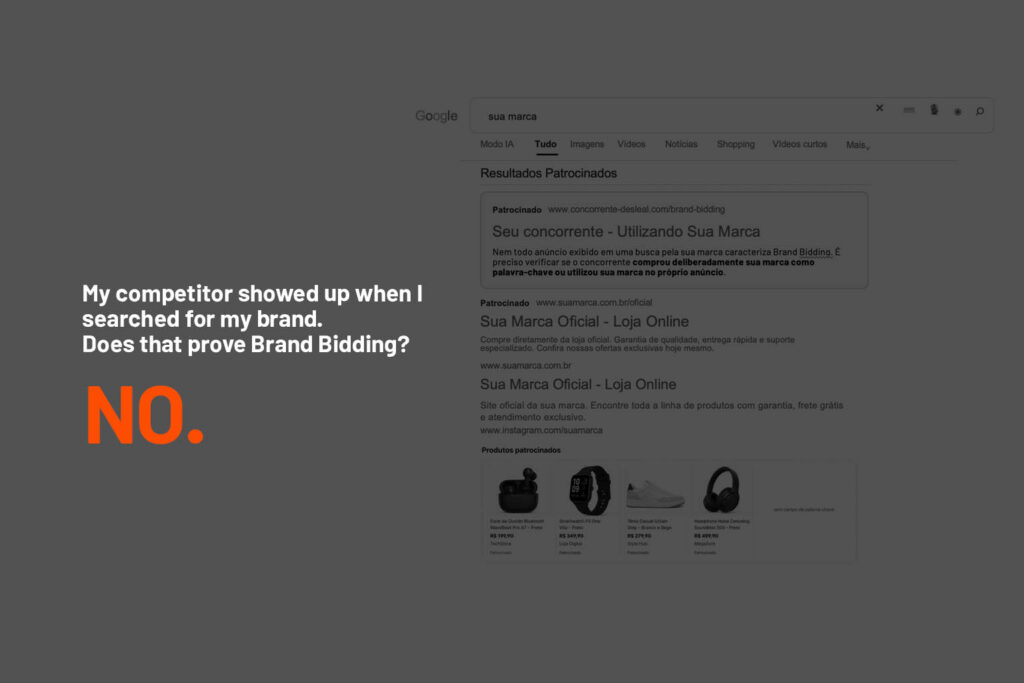
No.
Seeing a competitor’s ad when you search for your company name is a signal worth investigating, but the ad appearing by itself does not prove that the competitor purchased your brand name as a Google Ads keyword.
Google Ads uses multiple matching systems, automation features and AI-driven campaign types. Because of that, a search containing your brand name may trigger a competitor’s ad even when your company name was never directly added as a keyword.
To identify a potential Brand Bidding case correctly, you need to understand why the ad was triggered, not simply whether it appeared on the search results page.
What is Brand Bidding?
In paid search, Brand Bidding generally refers to a strategy in which an advertiser intentionally competes for searches associated with a specific brand.
For example:
Company A deliberately adds:
Company B
as a keyword or uses targeting mechanisms specifically designed to compete for searches related to Company B.
That is different from simply:
Searching for “Company B” on Google and seeing an ad from Company A.
The second situation proves that an ad was displayed for that search query.
It does not, by itself, prove which targeting mechanism caused the ad to appear.
Why can a competitor appear without buying my brand name?
There are several possible explanations within Google Ads.
1. Broad match
Search campaigns can use broad match keywords.
According to Google Ads, broad match allows ads to appear for searches that are related to the advertiser’s keyword, even when the user does not enter exactly the same words.
For example, an advertiser may bid on:
brand protection
and Google’s systems may determine that other searches are commercially relevant to that keyword.
Google also uses additional signals to understand search intent and relevance, including landing page content, other keywords in the ad group and contextual signals.
That is why:
Search query ≠ necessarily the keyword purchased by the advertiser.
This distinction is critical in a Brand Bidding investigation.
2. Even exact match does not always mean identical text
Another important detail is that exact match does not necessarily require the user’s search to be character-for-character identical to the keyword.
Google Ads explains that exact match can include searches with the same meaning or intent.
Close variants may also include:
- spelling variations;
- singular and plural forms;
- abbreviations;
- reordered words;
- other searches Google considers equivalent in intent.
So looking only at what the user typed does not necessarily reveal what keyword existed inside the advertiser’s account.
3. Performance Max can appear in Search without traditional keywords
This is one of the biggest sources of confusion when investigating potential Brand Bidding.
Performance Max campaigns can serve ads on Google Search, but they do not operate exclusively through traditional keyword lists.
Google uses AI, campaign assets, landing pages, audience signals and other data to identify potential conversion opportunities across its advertising inventory.
Performance Max can also use search themes.
Search themes help Google’s AI understand which searches may be relevant to the business, but they are not the same thing as traditional Search campaign keywords.
This means a scenario such as this is technically possible:
User searches:Brand X
Advertiser campaign:
Performance Max
Keyword “Brand X” directly added:
None
The ad may still become eligible for that search depending on the campaign’s signals and Google’s relevance systems.
So how do you prove Brand Bidding?
The investigation needs to go beyond the Google search results page.
A screenshot is useful because it records what happened.
It does not necessarily explain why it happened.
The key question is:
What targeting mechanism caused that advertiser to enter the auction?
The Search Terms Report is an important source of evidence
Google Ads provides a Search Terms Report, which shows the actual searches that resulted in ads being displayed.
For Search campaigns, Google may also provide information about the keyword associated with the query.
This makes it possible to distinguish very different situations.
Scenario A — stronger evidence of deliberate brand targeting
Search term:
Competitor Brand
Matching keyword:
Competitor Brand
This creates a much stronger indication that the brand was deliberately targeted and deserves deeper analysis.
Scenario B — the search was matched to a generic keyword
Search term:
Competitor Brand
Matching keyword:
brand protection
Here, the advertiser did not necessarily purchase the competitor’s brand name.
The ad may have been triggered through Google’s keyword matching system.
That is a very different technical situation.
Scenario C — Performance Max
Search term:
Competitor Brand
Campaign:
Performance Max
In this case, the investigation should consider:
- search themes;
- landing page content;
- campaign assets;
- audience signals;
- brand exclusions;
- campaign settings;
- Google’s automated targeting.
There may not be a traditional keyword corresponding directly to the brand.
What if the competitor uses my brand name inside the ad?
That is an important signal, but it should be analyzed separately.
There are two different questions:
1. Why was the advertiser eligible for the search?
and
2. What did the advertiser display in the ad?
If a competitor explicitly uses another company’s brand in:
- the headline;
- the description;
- the display URL;
- ad assets;
that may indicate deliberate use of the brand and deserves additional trademark and legal analysis.
However, technically, the ad copy alone still does not prove which keyword triggered the auction.
A robust investigation therefore separates:
ad targeting
from
ad content.
Not every competitor appearance should automatically be classified as Brand Bidding
This distinction matters.
Treating every competitor ad that appears on a branded search as confirmed Brand Bidding can create false positives.
Google Ads itself provides several mechanisms for advertisers to control branded traffic, including:
- negative keywords;
- brand exclusions;
- brand inclusions;
- Search campaign controls;
- Performance Max controls.
These tools exist precisely because Google’s advertising ecosystem is increasingly automated.
The fact that Google provides brand exclusion controls also illustrates an important point:
An advertiser can become eligible for brand-related searches without necessarily having manually entered that brand as a keyword.
What should a proper Brand Bidding investigation analyze?
A technically sound investigation should answer at least these questions:
- What exact search term did the user enter?
- Which advertiser appeared?
- Which campaign generated the impression?
- Was it Search, Performance Max or another campaign type?
- Which keyword matched the search, if applicable?
- What match type was being used?
- Were search themes involved?
- Was the competitor’s brand deliberately included in targeting?
- Was the brand used in the ad copy?
- Were brand exclusions or negative keywords configured?
- Was the occurrence isolated or repeated?
- Is there consistent historical evidence of deliberate targeting?
The more evidence available, the stronger the diagnosis.
Appearance is evidence. It is not a conclusion.
This is the most important distinction.
Seeing a competitor’s ad when searching for your brand means:
There is an occurrence worth investigating.
It does not automatically mean:
The competitor purchased my trademark as a keyword.
Google Ads has become significantly more automated.
Broad match, search intent, Performance Max, search themes, landing-page signals and AI-based targeting can all influence which advertisers participate in an auction.
That is why Brand Bidding should be investigated using:
evidence, technical context and traceability.
Not screenshots alone.
How Offertech investigates potential Brand Bidding cases
At Offertech, the goal is not simply to identify which competitors appeared for a branded search.
The objective is to understand what caused the occurrence and distinguish between:
- normal Google Ads matching behavior;
- automated campaign delivery;
- generic category competition;
- possible deliberate brand targeting;
- potentially improper use of a brand in advertising.
This approach helps reduce false positives and gives marketing, legal and executive teams better information before deciding how to respond.
Did a competitor appear when someone searched for your brand?
Don’t assume.
Investigate first.
Talk to Offertech specialists and request a brand diagnosis.
FAQ: Brand Bidding on Google Ads
My competitor appeared when I searched for my company. Did they buy my keyword?
Not necessarily.
Google Ads can display ads because of keyword matching systems, search intent, automation and campaigns such as Performance Max.
The presence of the ad alone does not prove that your brand was directly purchased as a keyword.
Does a Google screenshot prove Brand Bidding?
No.
A screenshot proves that an advertiser appeared for a specific search at a specific moment.
It does not necessarily reveal the keyword, campaign configuration or automated mechanism responsible for the impression.
How can I identify which keyword triggered an ad?
For Search campaigns, Google Ads’ Search Terms Report can help identify the queries that generated impressions and clicks.
Depending on the campaign and available reporting, advertisers may also see which keyword matched the user’s search.
This is much stronger evidence than relying only on the search results page.
Can Performance Max show an ad when someone searches for a competitor?
Yes.
Performance Max can serve ads on Search and uses AI-driven targeting rather than relying exclusively on conventional keyword lists.
Google also provides brand exclusion controls for advertisers that want to prevent campaigns from serving on searches associated with specific brands.
Does using my trademark in the ad prove that my competitor bought my keyword?
Not necessarily.
Using the trademark in the ad and purchasing the trademark as a keyword are different technical issues.
Both may deserve investigation, but one does not automatically prove the other.
Do advertisers have to negatively target every competitor brand?
No.
Negative keywords and brand exclusions are campaign management tools.
They are not a technical requirement for every advertiser to automatically exclude every competitor in the market.
Overusing exclusions can also unnecessarily restrict campaign reach.